
SDG 5: GENDER EQUALITY
Al Ain University

Contents
- Policy of Non-Discrimination Against Women
- 1. AAU meets THE Indicator 5.6.1
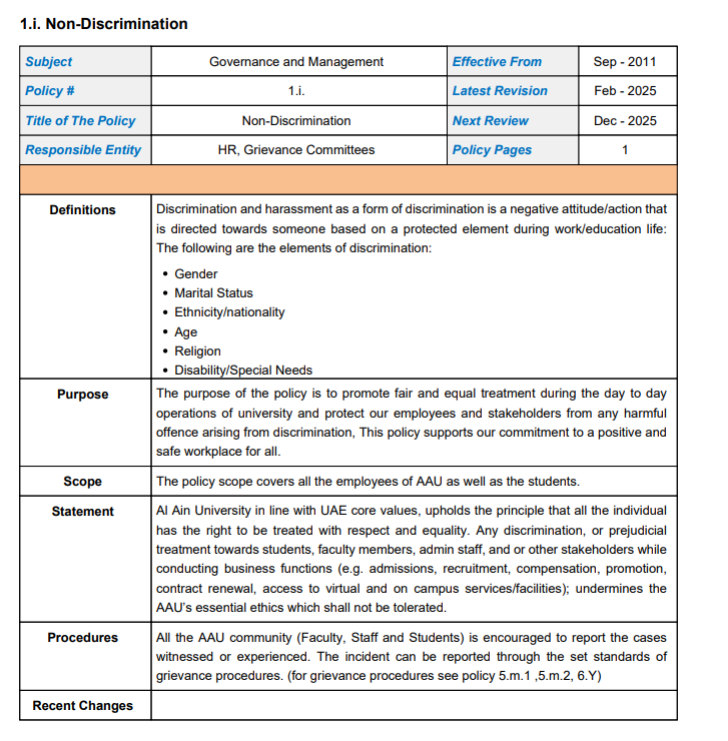
- Non-Discrimination
- Diversity In the University
- Students’ Grievance Committee
- Harassment or Discrimination
- 1.1 Correct indicator alignment
- 2. The Non-Discrimination Policy establishes protection, scope and remedy
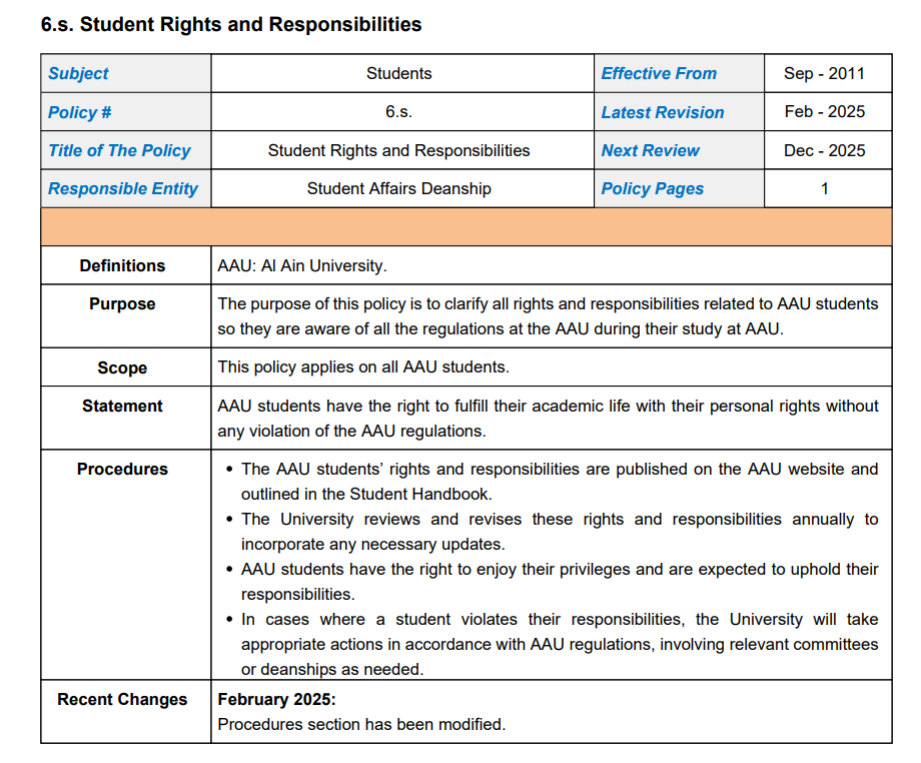
- Student Rights and Responsibilities
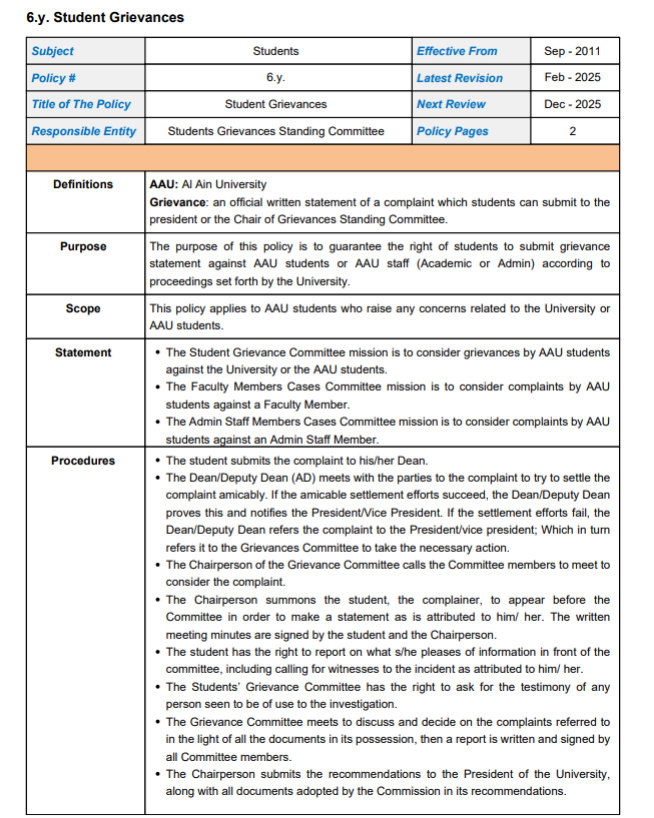
- Student Grievances
- Staff Grievances
- 3. AAU combines equal rights with support for different circumstances
- Student Counseling
- Health Services
- Co-education Policy
- Campus facilities for disable and maternity care
- 3.1 Gender justice and human rights
- 4. Employment conditions are role-based and gender-neutral
- 5. Pay equity is supported by policy, measurement and legal obligation
- 5.1 National alignment and current pay-equity practice
- 6. Family-related provisions protect women's continued participation
- 7. Women are protected through prevention, reporting, support and accountability
- 7.1 Rights and protection awareness
- 8. Policy principles are visible in AAU's 2024 institutional practice
- 9. QAA's 2024 review confirms non-discriminatory employment practice
- 10. Women’s opportunity and participation remain active in 2025-2026
- 10.1 Independent partnership confirmation
- 11. AAU has a comprehensive policy of non-discrimination against women
- 11.1 Submission evidence summary
- 12. Evidence register
- 12.1 Employment, pay and remedy
- 12.2 Family support, legal alignment and independent review
- 12.3 Implementation and current continuity
SUSTAINABLE DEVELOPMENT GOAL 5
Policy of Non-Discrimination Against Women
DIRECT RESPONSE: YES - FORMAL, PUBLIC AND INSTITUTION-WIDE
Al Ain University maintains a published Non-Discrimination Policy that expressly protects gender and marital status, rejects prejudicial treatment and harassment, and applies to students and employees while extending the University's non-tolerance standard to faculty, administrative staff and other stakeholders. The policy is reinforced by equal-opportunity recruitment, role-based employment conditions, pay-scale equity evidence, grievance and discipline procedures, maternity and paternity provisions, childcare and maternity-support facilities, and current women-empowerment activity.
INSTITUTIONAL RESPONSE
1. AAU meets THE Indicator 5.6.1
THE's 2026 methodology classifies this question as Indicator 5.6.1, Policy of non-discrimination against women, and requires the policy to have been in place by 2024. AAU's Non-Discrimination Policy was in force during the evidence year and remains publicly accessible through the University's policy and SDG portals. The policy expressly identifies gender and marital status among its protected characteristics and requires fair and equal treatment within the University environment.
THE requirement | AAU institutional control | Scope | Public confirmation |
Policy exists | Published Non-Discrimination Policy | Students and employees; policy statement covers faculty, staff and other stakeholders | AAU policy and SDG 5.6.1 evidence pages |
Women are protected | Gender and marital status are expressly protected | Academic participation, employment, services and institutional treatment | Policy, handbooks and diversity statement |
Discrimination is prohibited | Discrimination, prejudicial treatment and harassment are not tolerated | Decisions, conduct and participation | Policy, rights, grievance and discipline procedures |
Policy is operational | Governance, Human Resources, academic management and case-management routes | Recruitment, promotion, pay, support, reporting and accountability | AAU employment evidence and QAA 2024 review |
Policy is current | In place by 2024 and currently published | Both campuses and current University activity | Current AAU website, handbooks and 2025-2026 continuity |
Public evidence: E01 | E02 | E03 | E04 | E05 | E08 | E09 | E11
Non-Discrimination
Diversity In the University
AAU strongly believes diversity to be fundamental to academic excellence as the values of equal opportunity to access education are deeply-rooted in the UAE diverse community. Experience has shown that the more varied the backgrounds and perspectives of students and faculty, the richer the academic experience becomes.
For faculty and professional staff, diversity reinforces ties in the workplace leading to the ultimate success and realization of goals. Similarly, for students, learning in a diverse educational environment affords students the opportunity for personal growth, instills the values of mutual respect, and builds
the spirit of teamwork leading to a generation of professionals who will be able to help build a closely-knit community.
Moreover, working towards the future requires raising a generation of professionals who are able to work in a diverse, pluralistic workplace, and who deal with others on the basis of contribution and character. To that end, AAU strives to create a healthy diverse atmosphere where students and faculty from all backgrounds and origins can positively interact and effectively contribute to the exchange of information and the flow of knowledge in a way that assists each and every one of them in the pursuit of their goals hence contributing to achieving the mission of AAU.
At AAU’s diverse learning environment, faculty and students come together in a welcoming and respectful setting that allows access to education for all and offers them the maximum opportunity for a culturally diverse experience.
Students’ Grievance Committee
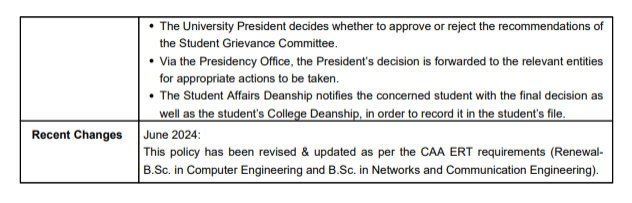
At the beginning of each academic year the Deans Council forms a Student Grievance Committee. Its mission is to consider the complaints reported by students regarding issues not listed within the university’s instructions, such as a complaint from a student against another or from the student against the university
The Mechanism of the Student Grievance Committee:
1. The student submits the complaint to his/her Dean/Deputy Dean (AD)
2. The Dean/Deputy Dean meets with the parties to the complaint to try to settle the complaint amicably. If the amicable settlement efforts succeed, the Dean/Deputy Dean proves this and notifies the President/Vice President. If the settlement efforts fail, the Dean/Deputy Dean refers the complaint to the President/vice president; Which in turn refers it to the Grievances Committee to take the necessary action.
3. The Chairperson of the Grievance Committee calls the Committee members to meet to consider the complaint.
4. The Chairperson summons the student, the complainer, to appear before the Committee in order to make a statement as is attributed to him/ her. The written meeting minutes are signed by the student and the Chairperson.
5. The student has the right to report on what s/he pleases of information in front of the committee, including calling for witnesses to the incident as attributed to him/ her.
6. The Students’ Grievance Committee has the right to ask for the testimony of any person seen to be of use to the investigation.
7. The Grievance Committee meets to discuss and decide on the complaints referred to in the light of all the documents in its possession, then a report is written and signed by all Committee members.
8. The Chairperson submits the recommendations to the President of the University, along with all documents adopted by the Commission in its recommendations.
9. The University President decides whether to approve or reject the recommendations of the Student Grievance Committee.
10. Via the Presidency Office, the President’s decision is forwarded to the relevant entities for appropriate actions to be taken.
11. The Student Affairs Deanship notifies the concerned student with the final decision as well as the student’s College Deanship, in order to record it in the student’s file.
Harassment or Discrimination
Al Ain University upholds the principle that all individuals have the right to be treated with respect and equality. Any harassment, discrimination, or prejudicial treatment towards peers, faculty members, or administrative staff on grounds of ethnicity, religion, national origin, gender, age, or disability status undermines the AAU’s essential ethics and shall not be tolerated.
1.1 Correct indicator alignment
The current methodology separates this policy question from Indicator 5.3.1, which measures and tracks women's application and entry rates. This submission is therefore confined to the policy against discrimination toward women and its supporting employment, pay, safeguarding and participation controls.
Public evidence: E01
FORMAL POLICY ARCHITECTURE
2. The Non-Discrimination Policy establishes protection, scope and remedy
AAU's policy provides a safe working and learning environment in which members of the University community are treated fairly and equally. Its protected grounds include gender, marital status, ethnicity or nationality, age, religion, disability and special needs. Its institutional statement rejects discriminatory or prejudicial treatment of students, faculty, administrative staff and other stakeholders, and it treats harassment within the non-discrimination framework.
Policy component | AAU provision | Protection for women |
Purpose | Fair, equal and safe environment | Women must receive equal treatment in study, work and services |
Protected characteristics | Gender and marital status are express grounds | Protection is specific to sex and family status, not implied only through a general statement |
Prohibited conduct | Discrimination, prejudicial treatment and harassment are not tolerated | Women are protected from exclusion, adverse treatment and gender-based harassment |
Scope | Employees and students, with the statement extending to faculty, administrative staff and stakeholders | Both academic and employment relationships are covered |
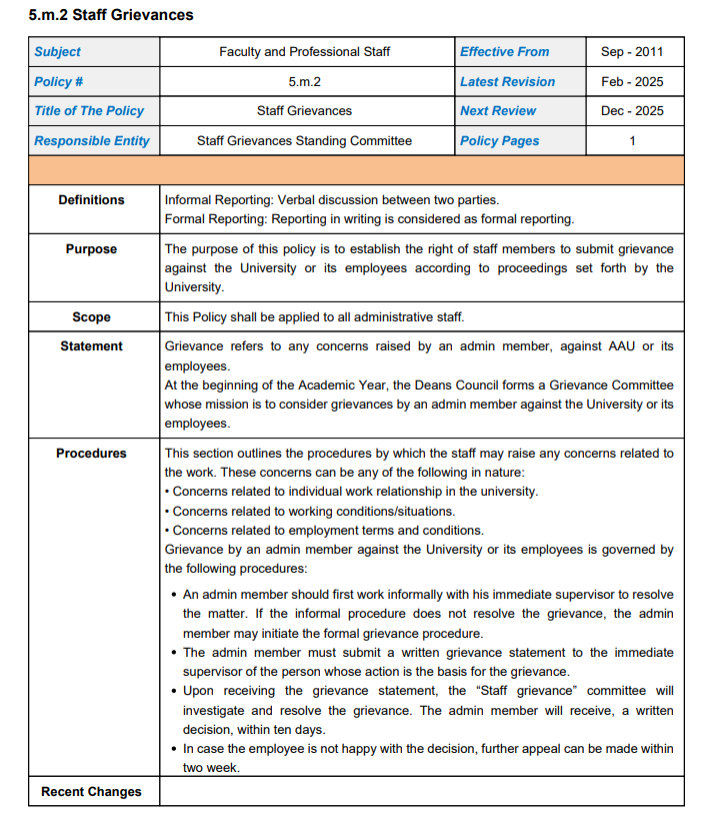
Reporting | Experienced or witnessed discrimination may be raised through grievance procedures | Affected women and witnesses can activate institutional review |
Accountability | University governance, Human Resources and academic or administrative authorities | Responsibility is assigned to institutional decision-makers |
Public evidence: E04 | E05 | E06 | E13 | E14 | E18 | E19
Student Rights and Responsibilities
Student Grievances
Staff Grievances
INSTITUTIONAL STANDARD
A woman's access, participation, employment, progression, remuneration, support and treatment are governed by the same institutional commitment to merit, fairness, dignity and equality.
COMPLEMENTARY AND SUBSTANTIVE GENDER EQUALITY
3. AAU combines equal rights with support for different circumstances
AAU's approach reflects substantive and complementary gender equality: women and men have the same institutional rights, duties and access to opportunity, while sex-specific and family-related needs are addressed through maternity, paternity, childcare, health, counselling and facility provisions. These supports do not create different academic or employment standards; they remove barriers that could prevent women from participating on equal terms.
Equality principle | Common standard | Differentiated support | Result |
Equal educational rights | Same academic rights, responsibilities, conduct and completion standards | Counselling, health and maternity-related support where required | Women participate and progress without reduced standards or disadvantage |
Equal employment rights | Role-based recruitment, promotion, contract, duties and discipline | Maternity, paternity and family-support measures | Women retain equal career opportunity alongside family responsibilities |
Equal facilities and opportunity | Co-education policy states equal facilities and educational opportunities for both sexes | Separate or dedicated facilities where culturally or practically appropriate | Equal access is preserved within the UAE social context |
Equal voice and remedy | The same grievance and appeal routes apply | Counselling, health, referral and protection against retaliation | Women can seek support and redress without loss of rights |
Equal dignity and human rights | Respect, non-discrimination and contribution-based treatment | Targeted women-empowerment and leadership activity | Formal equality is reinforced by practical opportunity |
Public evidence: E04 | E07 | E09 | E10 | E11 | E12 | E13 | E15 | E16 | E34 | E35 | E36 | E38 | E39 | E40
Student Counseling
Health Services
Co-education Policy
Purpose
This policy aims at providing an effective active learning environment to meet UAE needs concomitant with preparing a knowledgeable, conscious and refined generation in an academic and social context proper to the Emirati society.
Policy Implementation Area
Al Ain University Students
Definitions of the Policy
University: Al Ain University
Policy Statement
Based on the instructions issued by the Abu Dhabi Department of Education and Knowledge on the policy of co-education and separate education in institutions of higher education in the Emirate of Abu Dhabi, the university adopts both mixed-gender education and single-gender education policy as follows:
- The University applies the policy of complete separation and partial mixing and has taken exclusive measures to implement this policy.
- Al Ain University Science and Technology follows the policy of separating both genders in public facilities and partially separating them in classrooms and laboratories.
- The university provides equal facilities and education opportunities for both sexes.
- The University believes in the positive impact of cultural, gender and linguistic diversity in the enrichment of its intellectual and social environment.
Policy Procedures
The University’s infrastructure, facilities and services are adequate enough to support the implementation of this policy which is being applied following the measures mentioned below:
Classrooms and laboratories:
The classrooms and laboratories are equipped to accommodate students of both sexes where male students sit separately form female students in the same classroom in the sections numbered (61, 62, 63), as well as the allocation of separate classrooms bearing section numbers (51, 52, 53) for female students and section numbers (1, 2, 3) for male students.
Service facilities for students:
There are separate entrances and parking spaces for male students and for female students.
A separate room for female students and for male students in the admission and registration services as well as in the finance services.
The university provides the following facilities independently and separately for students:
- Restaurants
- Library
- Praying area
- Recreation areas
- Sports facilities
Responsibilities
- The Board of Trustees is the authorized body to adopt this policy and the procedures for its implementation
- The University President oversees the implementation of this policy and its procedures.
- The College Deans and members of the academic and administrative bodies apply the procedures of this policy.
- The Quality Assurance and Institutional Research Center evaluates the effectiveness of this policy and its procedures.
Campus facilities for disable and maternity care
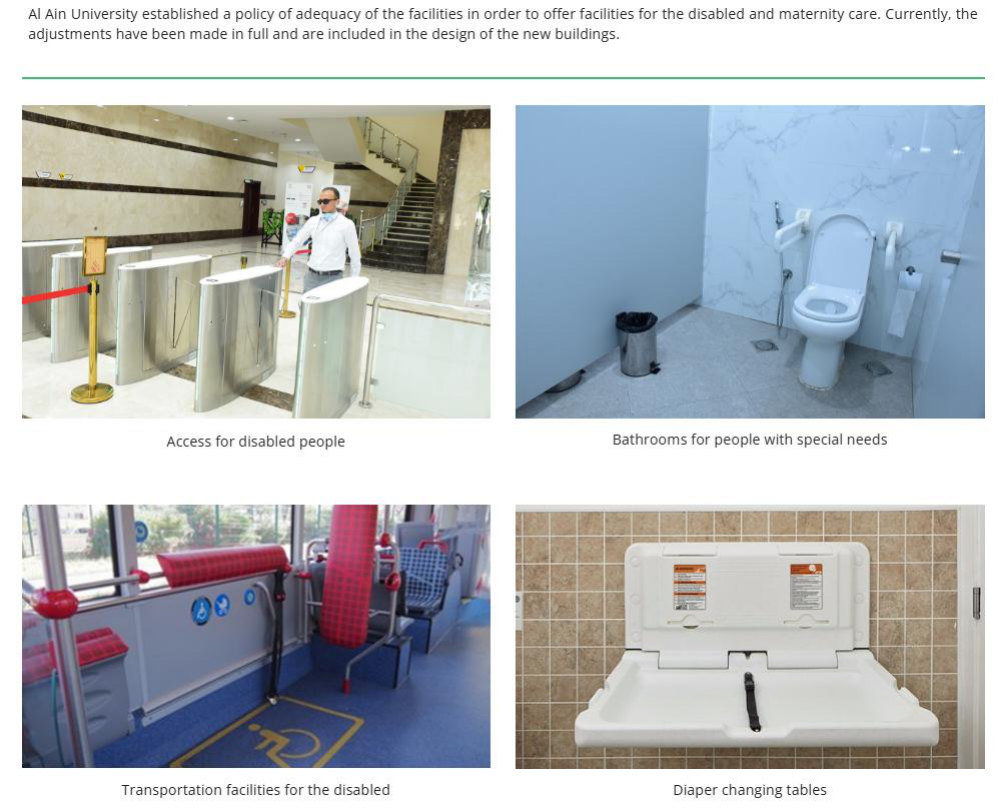
3.1 Gender justice and human rights
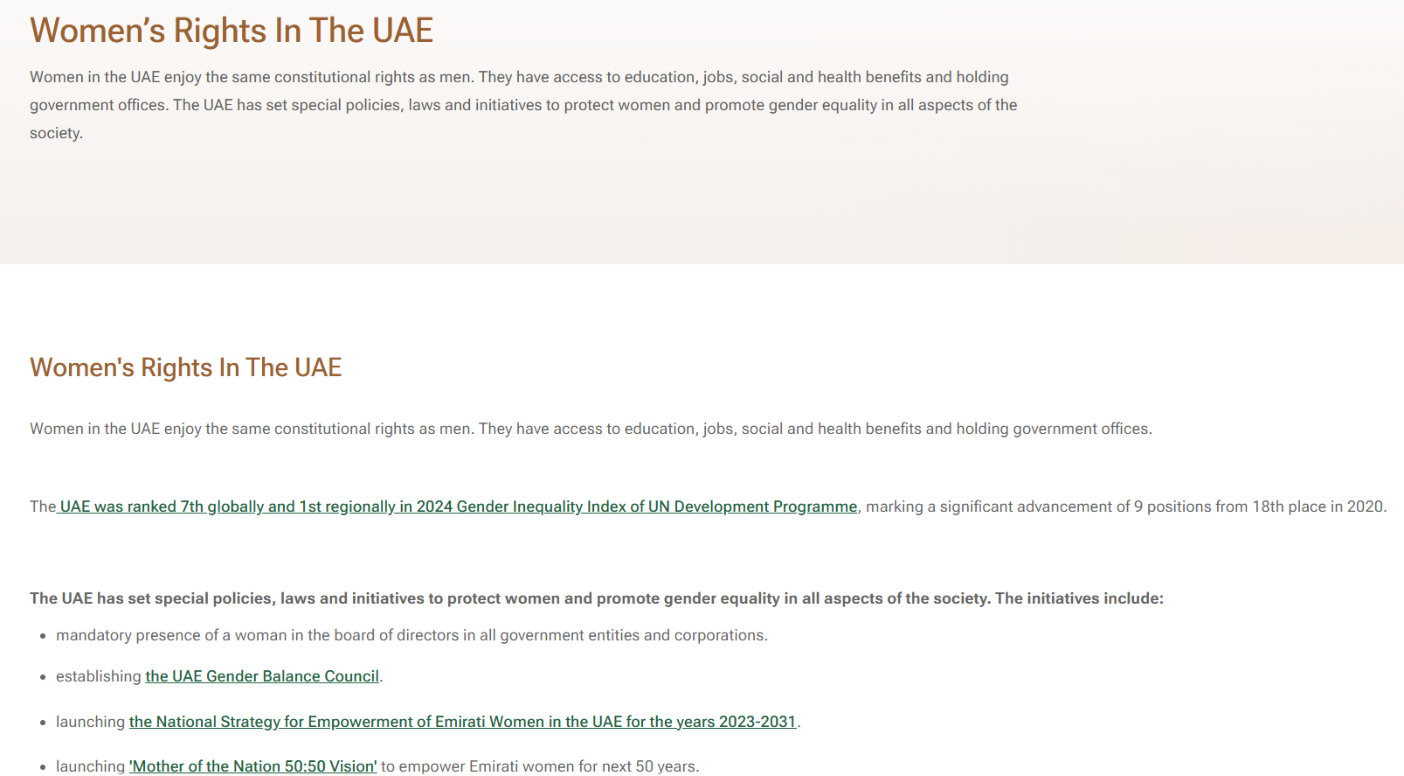
Gender justice at AAU means that sex or marital status cannot be used to restrict access, impose disadvantage or reduce recognition for contribution. The University's diversity statement supports interaction based on contribution and character, and AAU's policy aligns with the UAE's constitutional, employment and women's-rights framework.
Public evidence: E04 | E07 | E42 | E44 | E45
EQUAL RIGHTS AND DUTIES AS EMPLOYEES
4. Employment conditions are role-based and gender-neutral
AAU's employment framework applies the same professional rights and duties to women and men performing equivalent roles. Recruitment and appointment are based on qualifications and role requirements; promotion and contract renewal follow published criteria; duties are determined by the position; compensation and benefits are governed by institutional policy; and grievance, appeal and discipline routes apply to employees without gender distinction.
Employment stage | AAU control | Equal-rights effect | Women's protection |
Recruitment and appointment | Faculty and staff recruitment policies plus Non-Discrimination Policy | Selection is based on qualification, merit and role need | Gender cannot be used as an adverse selection criterion |
Job duties and performance | Faculty and professional staff roles and employment contracts | Responsibilities are attached to the role, not to the employee's gender | Women and men in equivalent roles carry equivalent professional duties |
Promotion and renewal | Published staff promotion and contract-renewal controls | Progression is linked to institutional criteria and performance | Women have the same route to continued employment and advancement |
Compensation and benefits | Compensation policy and public pay-equity evidence | Salary and benefits follow job value and institutional scales | Equal pay applies to work of equal value and quality |
Grievance and appeal | Staff, faculty and SDG 8.2.8 appeal routes | Employees can challenge treatment, rights or pay decisions | Women have an accountable remedy for disadvantage |
Discipline | Published staff discipline procedures | The same conduct standards and process apply | Accountability is consistent and gender-neutral |
Public evidence: E04 | E11 | E12 | E18 | E19 | E20 | E21 | E22 | E23 | E24 | E25 | E26 | E27 | E33
SAME RIGHTS AND DUTIES
AAU's employment rules attach rights, responsibilities, progression and remuneration to the job and its requirements. They do not create a separate or inferior employment status for women.
EQUAL PAY FOR WORK OF EQUAL VALUE
5. Pay equity is supported by policy, measurement and legal obligation
AAU publishes a dedicated employment pay-scale equity evidence page under SDG 8.2.6 and a dedicated gender pay-scale tracking evidence page under SDG 8.2.7. These public controls sit alongside the University's Compensation and Benefits Policy, non-discrimination requirements, employment-grievance routes and appeal process. Together they establish that remuneration should be determined by the value and quality of work, role, qualification and performance rather than gender.
Pay-equity layer | Evidence and mechanism | Institutional effect |
Non-discrimination | Gender is an express protected ground | Compensation decisions cannot lawfully or institutionally disadvantage women |
Pay-scale equity | AAU SDG 8.2.6 public page and evidence document | AAU publishes an institutional commitment to equitable pay scales |
Gender tracking | AAU SDG 8.2.7 public page and evidence document | Gender equity in pay scales is subject to measurement and review |
Compensation administration | Compensation and Benefits Policy and role-based employment documents | Pay and benefits are linked to employment classification and job requirements |
Appeal and remedy | Staff or faculty grievance and employment appeal routes | Employees can challenge rights or pay-related disadvantage |
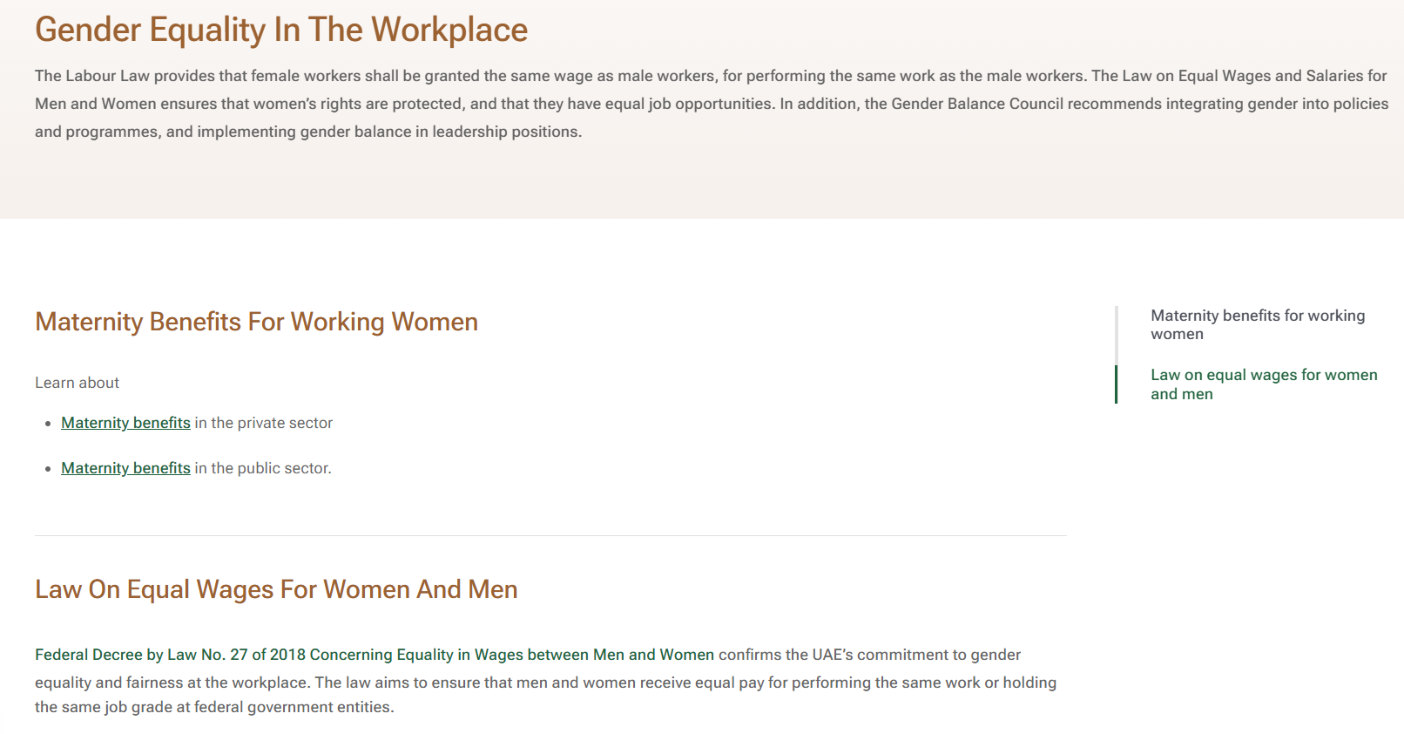
UAE legal floor | Federal employment and equal-wage legislation | Women are entitled to equal pay for the same work or work of equal value |
Public evidence: E04 | E18 | E19 | E24 | E29 | E30 | E31 | E32 | E33 | E42 | E43 | E45
5.1 National alignment and current pay-equity practice
The UAE's employment framework prohibits sex-based discrimination and requires equal wages for men and women performing the same work or work of equal value. In 2025, the UAE Gender Balance Council and World Bank convened public- and private-sector leaders to advance objective job evaluation and practical mechanisms for identifying and addressing gender pay gaps. AAU's pay-scale equity and tracking evidence operates within this national standard.
Public evidence: E42 | E43 | E45 | E46
PARTICIPATION, MATERNITY AND FAMILY SUPPORT
6. Family-related provisions protect women's continued participation
AAU complements formal equality with measures that address pregnancy, maternity, childcare and shared family responsibility. The University publishes evidence for a maternity policy, childcare facilities for students, childcare facilities for staff and faculty, and a paternity policy. Its campus-facilities record identifies maternity-care facilities, diaper-changing provision, nursery and kindergarten services. These measures reduce barriers to study and employment without changing academic or professional standards.
Provision | Primary beneficiary | Equality function | Public evidence |
Maternity policy | Women employees and students as applicable | Protects participation during pregnancy, birth and recovery | AAU SDG 5.6.3 |
Paternity policy | Fathers | Supports shared childcare duties and reduces the unequal care burden on women | AAU SDG 5.6.9 |
Student childcare | Student parents | Allows recent mothers and other student parents to continue study | AAU SDG 5.6.4 |
Staff and faculty childcare | Employees with children | Supports retention and work-family balance | AAU SDG 5.6.5 |
Maternity and family facilities | Students, employees and visitors | Provides practical on-campus support | Maternity-care, nursery and kindergarten facilities |
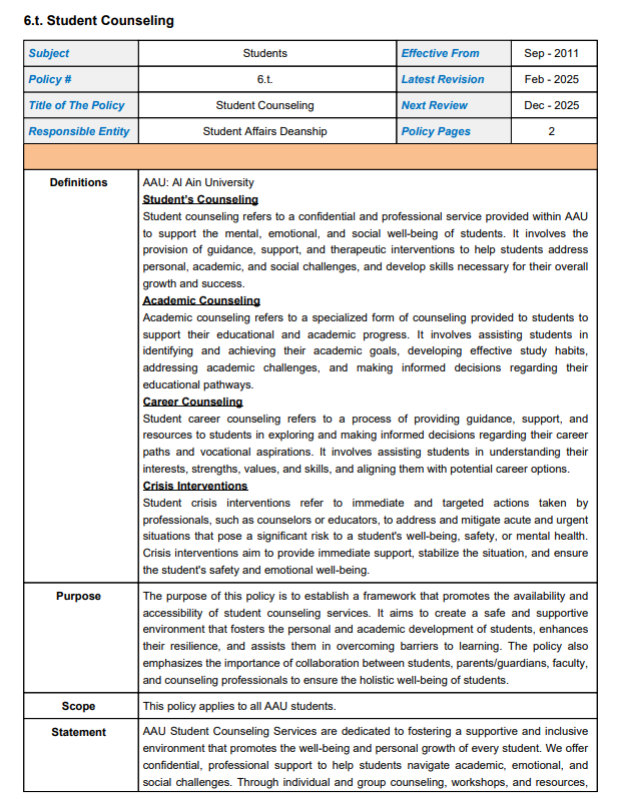
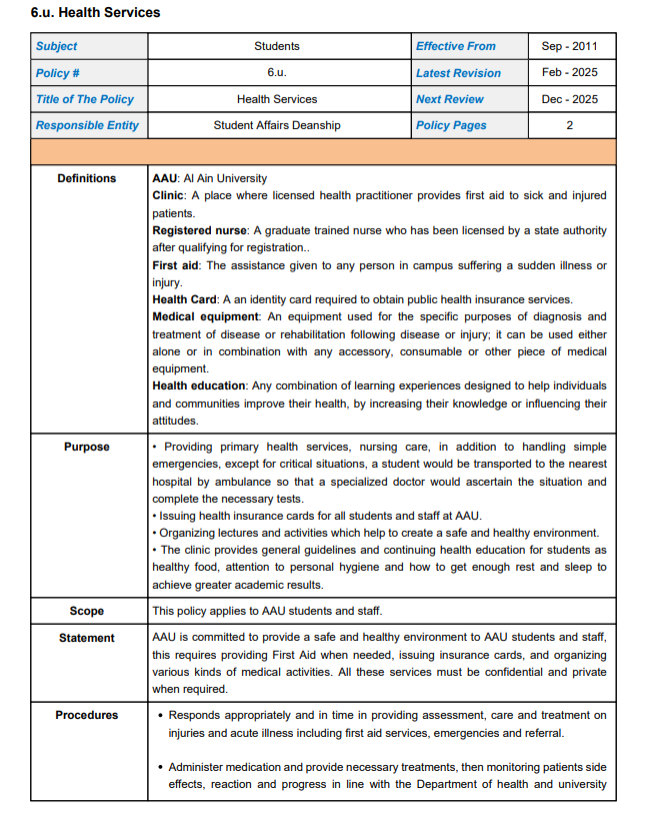
Counselling and health services | Students requiring academic, social, psychological or health support | Provides care, guidance and referral where family or health circumstances affect participation | AAU student policies |
Public evidence: E15 | E16 | E34 | E35 | E36 | E38 | E40
SUBSTANTIVE EQUALITY
Equal treatment is paired with practical support so that pregnancy, parenthood and caregiving do not become indirect barriers to women's education, employment or progression.
SAFETY, INAPPROPRIATE SEXUAL BEHAVIOUR AND REMEDY
7. Women are protected through prevention, reporting, support and accountability
THE's guidance requires a non-discrimination policy to cover inappropriate sexual behaviour. AAU addresses this requirement through its prohibition of harassment and gender-based discrimination, student and employee conduct standards, grievance procedures, counselling and health services, reporting protection, and student or staff discipline. The framework covers concerns affecting study, work, services or University-authorised activity and enables both an affected person and a witness to report conduct.
Safeguarding function | AAU route | Protection provided | Accountability |
Prevention and prohibition | Non-Discrimination Policy and handbooks | Gender discrimination, prejudicial treatment and harassment are not tolerated | Clear institutional conduct standard |
Reporting | Student, staff and faculty grievances | Experienced or witnessed conduct can be raised | Responsible authority receives and reviews the concern |
Protection from disadvantage | AAU SDG 5.6.8 reporting-protection evidence | Reporting must not result in educational or employment disadvantage | Retaliation risk is addressed institutionally |
Care and referral | Counselling and health services | Academic, social, psychological and health needs can be assessed and supported | Referral to specialised support where required |
Monitoring and follow-up | Grievance procedure and responsible management | Documentation, communication and institutional follow-up | Case is reviewed through an accountable route |
Discipline | Student and staff discipline procedures | Misconduct can lead to proportionate action | Consistent institutional enforcement |
Public evidence: E01 | E04 | E09 | E10 | E11 | E12 | E13 | E14 | E15 | E16 | E17 | E18 | E19 | E20 | E37
7.1 Rights and protection awareness
AAU's 2025 human-trafficking awareness workshop with the Family Care Authority adds current prevention and specialist-protection awareness to the formal case-management framework. It reinforces women's rights, recognition of exploitation and access to appropriate protection systems.
DATED 2024 IMPLEMENTATION
8. Policy principles are visible in AAU's 2024 institutional practice
AAU's evidence-year record combines formal policy with activity that recognises women's contribution, strengthens practical capability and supports family and community participation. These activities are implementation evidence: they demonstrate an institutional culture consistent with the policy, while the policy and employment controls remain the primary proof for this indicator.
2024 evidence | Partner or unit | Gender-equality contribution | Link to policy |
Emirati women's celebration | AAU and Burjeel Hospital | Recognises women's professional and social contribution | Women are visible, valued and included in institutional partnership activity |
My Farming, My Self-Sufficiency | AAU and General Women's Union | Supports practical capability, sustainability and self-sufficiency | Equal opportunity is connected to economic and community empowerment |
Mother's Day activity | College of Law | Recognises caregiving and women's social contribution | Family roles are respected alongside academic and professional participation |
Equal-opportunity recruitment | Human Resources and academic management | Recruitment and promotion decision-makers receive non-discrimination guidance | Institutional employment decisions apply the policy |
Equitable support | Both AAU campuses | Resources and support are available across locations | Women receive the same institutional access and support |
Public evidence: E04 | E41 | E47 | E48 | E49
POLICY IN PRACTICE
AAU's 2024 record shows women participating as students, employees, professionals, partners, caregivers and community contributors. The institutional framework protects each of these roles from gender-based disadvantage.
INDEPENDENT EXTERNAL CORROBORATION
9. QAA's 2024 review confirms non-discriminatory employment practice
The Quality Assurance Agency for Higher Education conducted an International Quality Review of AAU from 12 to 14 February 2024 and concluded that the University met all ten applicable European Standards and Guidelines. The published review independently records AAU's Non-Discrimination Policy and Human Resources guidance requiring staff involved in recruitment and promotion to observe it.
QAA also records clear, transparent and fair recruitment and describes AAU's equal-opportunity approach as selecting qualified candidates without discrimination on grounds including gender, race, religion or physical disability. It reports 209 full-time faculty members, with women representing 35% of the faculty profile, and identifies extensive professional-development opportunities for academic and administrative staff.
Independent finding | QAA confirmation | Relevance to women |
Formal policy | AAU has a Non-Discrimination Policy | Protection is documented and institutional |
Implementation | Human Resources guides recruitment and promotion decision-makers | The policy governs consequential employment decisions |
Fair recruitment | Recruitment is clear, transparent, fair and qualification-based | Women compete on merit under the same criteria |
Express gender protection | Equal-opportunity recruitment is reported regardless of gender | Independent review confirms no gender-based employment exclusion |
Development | Face-to-face, online, customised and funded professional development is available | Women have access to career and capability development |
Two-campus equity | Resources and support are equitably provided across both campuses | Location does not create a lesser institutional entitlement |
Public evidence: E04 | E21 | E41
INDEPENDENT CONFIRMATION
QAA's 2024 findings corroborate both the existence of AAU's policy and its operational use in recruitment and promotion. This directly supports the policy's credibility during the required evidence year.
CURRENT INSTITUTIONAL CONTINUITY
10. Women’s opportunity and participation remain active in 2025-2026
AAU's current public record shows that the University's formal non-discrimination framework is accompanied by continuing opportunity, leadership, entrepreneurship, research partnership, recognition and safeguarding activity for women.
Year | Current public evidence | Women's opportunity supported | Institutional continuity |
2025 | Empowering Women, Building Futures | Leadership, professional development and future participation | Women's advancement remains an explicit institutional theme |
2025 | Industry Business Day and Women Leadership Forum | Leadership, enterprise and professional networks | Women participate in high-level academic-industry engagement |
2025 | Emirati Women's Day participation | Recognition of Emirati women's achievement | AAU participates in national gender-equality culture |
2025 | General Women's Union collaboration | Research and community partnership | Institutional links support knowledge exchange benefiting women |
2025 | My Store for Productive Families | Economic participation and entrepreneurship | Women entrepreneurs receive a platform and public visibility |
2025 | AAU-AIWF memorandum of understanding | Entrepreneurship and economic inclusion in the UAE and MENA | External partner independently confirms a formal opportunity-building platform |
2026 | International Women's Day programme | Recognition of women's roles and contributions | Gender-equality awareness continues into the current year |
Public evidence: E50 | E51 | E52 | E53 | E54 | E55 | E56 | E57
10.1 Independent partnership confirmation
The Arab International Women's Forum independently reported the October 2025 memorandum of understanding signed at AAU's Abu Dhabi Campus. The partnership is designed to advance women's entrepreneurship and economic inclusion and to nurture innovation, leadership and opportunity for the next generation of women leaders in the UAE and wider MENA region.
Public evidence: E56
INSTITUTIONAL CONCLUSION
11. AAU has a comprehensive policy of non-discrimination against women
Al Ain University has a formal and publicly available Non-Discrimination Policy that expressly protects gender and marital status and rejects discrimination, prejudicial treatment and harassment. It applies to students and employees and extends the University's non-tolerance statement to faculty, administrative staff and other stakeholders. It was in place during the 2024 evidence year and remains part of AAU's current public policy architecture.
Women and men have the same academic and employment rights and duties. Recruitment, appointment, role responsibilities, promotion, contract renewal, discipline, grievance and appeal are administered through published, role-based controls. AAU's compensation framework, SDG 8.2.6 pay-scale equity evidence and SDG 8.2.7 gender pay-scale tracking evidence support equal pay for work of equal value and quality, aligned with UAE employment and equal-wage legislation.
AAU also achieves substantive gender justice by pairing common standards with maternity, paternity, childcare, health, counselling and family-supporting facilities. Reporting protection, grievance, counselling, health, referral and discipline routes address harassment and inappropriate sexual behaviour. QAA's independent 2024 review confirms the policy's operation in recruitment and promotion, while 2024 implementation and 2025-2026 continuity show that women continue to be recognised, supported and connected to leadership, research, entrepreneurship and economic opportunity.
FINAL RESPONSE: YES
AAU's policy framework protects women's equal dignity, rights, duties, participation, employment, progression and remuneration. It combines formal non-discrimination with practical support, accountable remedy and equal pay for work of equal value.
11.1 Submission evidence summary
THE evidence theme | AAU evidence | Institutional result |
Policy and protected status | Public Non-Discrimination Policy; gender and marital status expressly protected | Women are specifically protected by an institution-wide policy |
Equal rights and duties | Role-based recruitment, employment, promotion, grievance and discipline | Women and men are governed by the same professional standards |
Equal pay | Compensation policy, pay-scale equity evidence, gender tracking and UAE law | Equal pay applies to work of equal value and quality |
Substantive equality | Maternity, paternity, childcare, counselling, health and family facilities | Different circumstances are supported without lowering common standards |
Safety and remedy | Harassment prohibition, reporting protection, support, referral and discipline | Women can report concerns and obtain care and institutional redress |
Independent and current proof | QAA 2024 review and 2025-2026 opportunity-building activity | Policy implementation is externally corroborated and current |
Public evidence: E01 | E02 | E04 | E24 | E29 | E31 | E34 | E37 | E41 | E56
PUBLIC EVIDENCE
12. Evidence register
The following public sources support the policy, protected characteristics, employment rights and duties, pay equity, substantive gender equality, safeguarding, dated 2024 implementation, independent corroboration and current continuity presented in this submission.
ID | Year/type | Public source | Evidence supported |
E01 | THE 2026 | Current indicator number, scoring basis and policy guidance | |
E02 | AAU SDG | Public institutional SDG 5.6.1 evidence page | |
E03 | AAU SDG | Downloadable public SDG 5.6.1 evidence document | |
E04 | AAU policy | Core policy, gender protection, scope, harassment and reporting | |
E05 | AAU current | Public University Policies index | |
E06 | AAU policy | Consolidated University policy architecture | |
E07 | AAU current | Diversity, equal opportunity, respect and contribution-based culture | |
E08 | AAU current | Public SDG 5 institutional framework | |
E09 | AAU 2024-25 | Student policy framework during the evidence year | |
E10 | AAU 2025-26 | Current Student Handbook and policy continuity | |
E11 | AAU 2024-25 | Staff policy framework during the evidence year | |
E12 | AAU 2025-26 | Current Staff Handbook and policy continuity | |
E13 | AAU policy | Student rights, responsibilities and respectful conduct | |
E14 | AAU policy | Student reporting and grievance route | |
E15 | AAU policy | Counselling, care and referral support |
PUBLIC EVIDENCE CONTINUED
12.1 Employment, pay and remedy
ID | Year/type | Public source | Evidence supported |
E16 | AAU policy | Health support and referral route | |
E17 | AAU policy | Student discipline and accountability | |
E18 | AAU policy | Staff grievance and reporting route | |
E19 | AAU policy | Faculty grievance and reporting route | |
E20 | AAU policy | Staff discipline and accountability | |
E21 | AAU policy | Fair faculty recruitment and appointment | |
E22 | AAU policy | Role-based staff recruitment | |
E23 | AAU policy | Published staff promotion criteria | |
E24 | AAU policy | Compensation and benefits administration | |
E25 | AAU policy | Faculty and staff contract renewal | |
E26 | AAU policy | Role-based faculty and professional duties | |
E27 | AAU SDG | Employment non-discrimination evidence page | |
E28 | AAU SDG | Employment non-discrimination evidence document | |
E29 | AAU SDG | Employment pay-scale equity evidence page | |
E30 | AAU SDG | Employment pay-scale equity evidence document |
PUBLIC EVIDENCE CONTINUED
12.2 Family support, legal alignment and independent review
ID | Year/type | Public source | Evidence supported |
E31 | AAU SDG | Gender pay-scale tracking evidence page | |
E32 | AAU SDG | Gender pay-scale tracking evidence document | |
E33 | AAU SDG | Employment-rights and pay appeal process | |
E34 | AAU SDG | Maternity policy supporting women's participation | |
E35 | AAU SDG | Childcare facilities supporting student parents | |
E36 | AAU SDG | Childcare facilities supporting staff and faculty | |
E37 | AAU SDG | AAU SDG 5.6.8 protection for persons reporting discrimination | Protection against disadvantage after reporting discrimination |
E38 | AAU SDG | Paternity policy and shared childcare responsibility | |
E39 | AAU policy | Equal facilities and educational opportunities for both sexes | |
E40 | AAU current | AAU facilities for disability, special needs and maternity care | Maternity, nursery, kindergarten and family-support facilities |
E41 | Independent 2024 | QAA International Quality Review of Al Ain University - February 2024 | QAA confirmation of policy and non-discriminatory recruitment |
E42 | UAE law | UAE Federal Decree-Law No. 33 of 2021 on Employment Relationships | Employment non-discrimination and equal-pay framework |
E43 | UAE law | UAE Federal Decree-Law concerning equality in wages between men and women | Specific equal-wage legislation for women and men |
E44 | UAE official | Women's human rights and national protection | |
E45 | UAE official | Gender equality in the workplace |
AL AIN UNIVERSITY | SUSTAINABLE DEVELOPMENT GOAL 5
PUBLIC EVIDENCE CONTINUED
12.3 Implementation and current continuity
ID | Year/type | Public source | Evidence supported |
E46 | External 2025 | UAE Gender Balance Council: Equal Pay for Work of Equal Value workshop - 2025 | National pay-equity practice and objective job evaluation |
E47 | AAU 2024 | Recognition of Emirati women's contribution | |
E48 | AAU 2024 | My Farming, My Self-Sufficiency with the General Women's Union - 2024 | Capability and self-sufficiency with General Women's Union |
E49 | AAU 2024 | Recognition of motherhood and caregiving | |
E50 | AAU 2025 | Women's leadership, development and future opportunity | |
E51 | AAU 2025 | Women Leadership Forum and industry participation | |
E52 | AAU current | Permanent Women Leadership Forum platform | |
E53 | AAU 2025 | AAU participation in Emirati Women's Day celebrations - 2025 | Participation in Emirati Women's Day |
E54 | AAU 2025 | AAU and General Women's Union research and community collaboration - 2025 | Research and community collaboration with General Women's Union |
E55 | AAU 2025 | My Store for Productive Families supports women entrepreneurs - 2025 | Economic participation for women entrepreneurs |
E56 | External 2025 | Arab International Women's Forum and AAU memorandum of understanding - 2025 | Independent confirmation of AAU-AIWF opportunity partnership |
E57 | AAU 2026 | International Women's Day highlights women's role and contributions - 2026 | International Women's Day continuity |
E58 | AAU 2025 | Awareness workshop on human trafficking with Family Care Authority - 2025 | Safeguarding and protection awareness |
AAU | SDG 5.6.1 | 31